
Home Theatre Design
Things that separate a great cinema from a good one.
Drawn from over a decade of professional home theatre installations across Canberra and the ACT.

01 — Foundation
Plan, Plan,Plan.
Careful planning is the foundation of an exceptional outcome. When executed properly, it not only elevates the final result but also helps avoid costly mistakes — after all, measure twice, cut once. A professionally developed 3D model can play a critical role in visualising the space and eliminating potential issues before they arise.
- The optimal speaker configuration based on room size and acoustics
- Seating design — particularly for tiered layouts. A scaled drawing ensures front-row seating doesn't obstruct sightlines, and tier height directly influences ideal screen height.
- Screen size, determined by room dimensions, viewing distance and the projector's throw ratio. Orienting the cinema along the longer dimension significantly enhances the experience.
- Strategic equipment placement with thorough consideration of noise management, ventilation and cabling infrastructure

02 — Installation
Wire It Once, Wire It Right.
Mistakes in a home cinema setup are far more expensive to rectify than getting it right the first time. A common misconception is that general electrical experience translates into expertise in cinema installation — in reality, it rarely does.
Common issues we see include incorrect HDMI cabling, poorly positioned subwoofer placements and unsuitable projector mounting locations.
The hidden cost of cutting cornersThese mistakes often cost more to fix than installing the system correctly from scratch. Walls need to be opened, cables replaced entirely, and mounting locations rebuilt. Involve experienced professionals at the right stage — so your system is wired once, and wired right.

03 — Display
Match Screen Size to Your Room— and Your Projector's Throw Ratio.
Projectors are designed with varying throw ratios, which determine the size of the image they produce at a given distance. Two projectors mounted at the same distance can deliver vastly different image sizes.
Homeowners often select projectors and screens without fully considering room dimensions or the maximum image size achievable in the available space — resulting in a system that never reaches its full potential.
LUMIFI has developed a fantastic tool you can download here that will work out the recommended screen size based on your viewing distance. It also works out the mounting position of your projector along the length of the room based on its throw ratio and your screen size . It also has tools that work out the physical size of your screen (based on the diagonal size and the frame width). It also works out the reflected brightness based on your projector's available lumens and the gain value of your screen material. All you have to do is fill values in the yellow cells.
Use the calculator before you buyMost projector manufacturers provide online projection calculators. Use them to accurately determine the ideal screen size, screen height and projector mounting position — ensuring everything works seamlessly from the outset.

04 — Acoustics
Apply AcousticTreatment.
Many homeowners miss the opportunity to dramatically improve their cinema experience through acoustic treatment. Simple treatment applied in the right spot can bring massive improvements to dialogue intelligibility.
Placing absorbers on the first point of reflection alone can solve the age-old problem: "What did he say?" Acoustic treatment reduces the reverberation time of your cinema substantially — delivering a far better sonic experience without a complete room rebuild.

05 — Bass Management
It's All AboutThat Bass.
Reverberation time is typically higher at low frequencies because low-frequency wavelengths are much longer — creating standing waves that produce areas of reinforced bass and "nulls" where bass disappears entirely.
One of the most effective solutions is the strategic use of multiple subwoofers positioned along the length and width of the room. Three subwoofers typically provide better coverage than two, and four better still.
Bass is the most important component after dialogue intelligibilityGetting it right requires both multiple carefully placed subwoofers and investment in acoustic calibration software such as Dirac Live.

06 — Calibration
Get the Best FromYour System — Get It Calibrated.
High-end home cinemas and professional theatres rely on precise calibration of both video and audio. The two industry-leading tools are Calman for video calibration and Dirac for audio calibration.
Calman ensures your projector reproduces colours, contrast, brightness and gamma to industry standards — Rec.709 for HD or DCI-P3 for digital cinema. Dirac measures sound at multiple listening positions, creating digital filters to correct timing, phase and frequency response.
Paired together, Calman and Dirac take a system from "good" to truly professionalFor enthusiasts and audiophiles, this calibration is not optional — it is essential to unlock the full potential of a high-end home cinema.
07— Call us
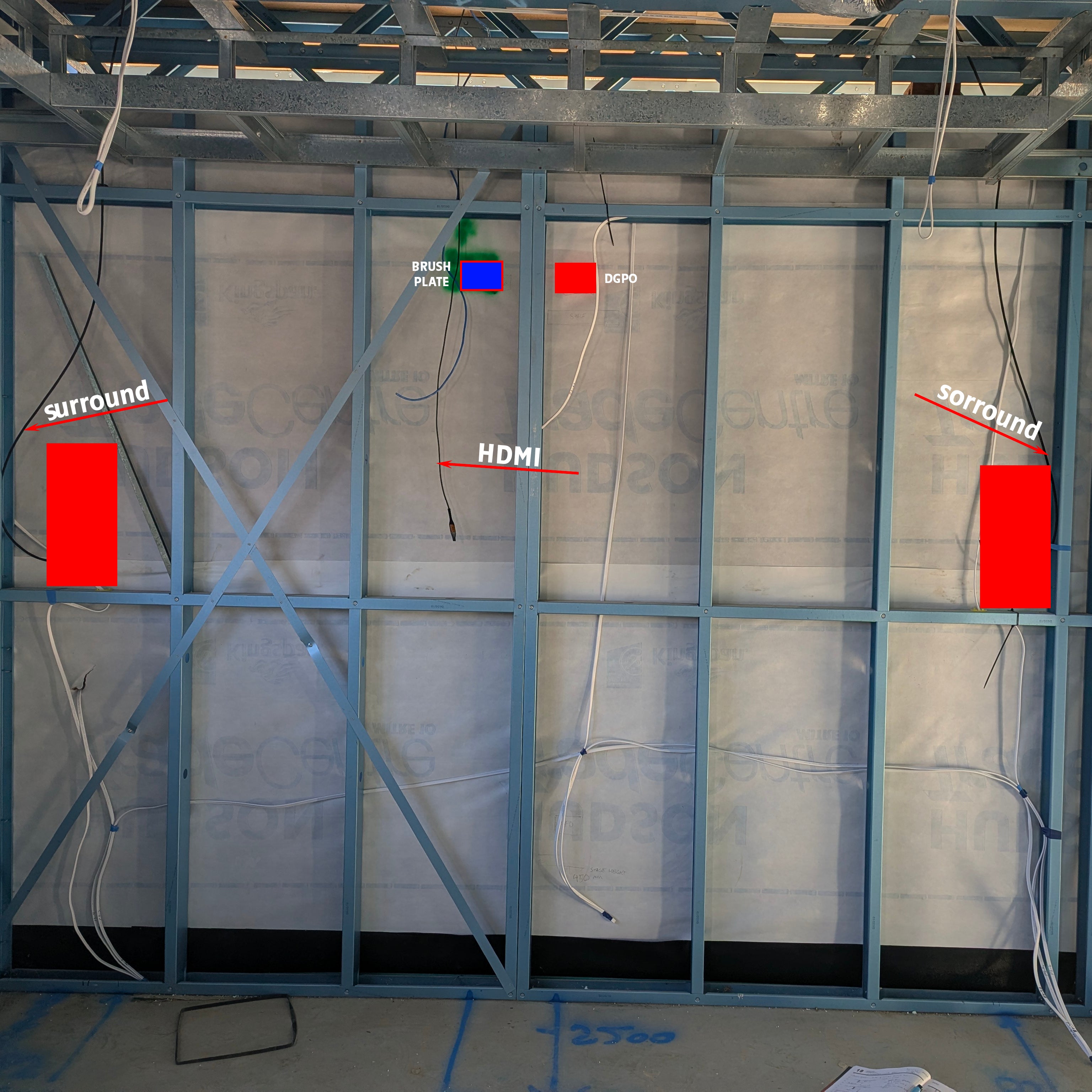
Not sure what to do - take advantage of our Rough in Service.
Don't let indecision stall your project. Contact us today for expert advice with zero upfront commitment. Our high-value "Rough-In" packages future-proofs your space, saving you from costly future alterations. This package includes a site consultation, premium cabling, professional pre-wiring labour, and full documentation to easily locate your cables later.
Don't waste thousands fixing wrong or cheap cables. Invest that budget into a higher-performing system insteadWe use premium Kordz cabling and provide complete photographic documentation of your setup. This layout transparency gives you total freedom to choose any provider for your final home theatre fit-out
THE DIFFERENCE
Before/after
A side-by-side look at how thoughtful lighting and system design transforms a space.

Before

After
Expert Advice
Get Help from Experts, at the Right Time.
Designing and installing a high-end home cinema is far more complex than placing a projector, screen and speakers in a room. Our specialists bring years of experience in room acoustics, speaker placement, projector positioning and audiovisual calibration — ensuring your investment performs flawlessly from day one.